Money lines (also called American Odds) are one of the most common ways to bet on sports. They do not use a point spread, and are straight-up bets on who will win the game or event.
To properly explain how to bet the money line, the first thing to understand is the difference between a negative and positive money line. Both money lines use $100 as the basis point for calculating payouts, but they’re calculated differently.
How to Calculate Money Line Payouts
Selection Is Key. In the same way the real estate is about location, location, location, betting on the. In this document on the different terms used in sports betting lines, including probabilities point spreads lines etc. One of the first aspects of sports betting every new player must learn what the different symbols mean. A plus or minus can mean different things and furious situation. They are used for both point spreads and money line bets. One of the most popular ways to bet on sports is the moneyline. This common betting option is used by new, recreational and experienced bettors and it’s one of the simplest. One of the most common types of sports betting lines when wagering on a game is the moneyline. You will see moneyline odds for every game and every sport played for the most part. While some games that have a very large spread but stray away from offering a moneyline, it is still one of the most popular styles of betting. Special NFL Betting Offer: BET $1 on Buccaneers money line, WIN $100 (in free bets) if Tom Brady throws a TD pass against the Chiefs. Offer available in CO, IA, IN, MI, NJ, PA, TN, VA and WV.
A negative money line is indicated with a ‘-‘ in front of a number, like -230. The number represents the amount of money that would need to be wagered in order to win $100 in profit. So, a -230 money line would require a wager of $230 to win $100 more, for a total payout of $330 ($230 wager + $100 profit). Of course a $230 bet is not required, it’s just the basis for calculating the payout. With odds of -230, a $23 bet would return $10 in profit, or a $2.30 bet would return $1 in profit.
A positive money line is indicated with a ‘+’ in front of a number. In this case, the number represents the amount that would be won from a $100 wager. So, a +170 money line means that a $100 wager would return $170 in profit, for a total payout of $270 ($100 wager + $170 profit = $270). A bet of $10 would result in a $17 profit, and a total payout of $27 ($10 wager + $17 profit = $27).
More About Negative Lines
Generally a negative money line represents the favored team in a match. There are exceptions to this and we’ll discuss that later. For now, think negative money line = favorite.
In most two-team games like football, baseball or soccer, one team will have a negative money line, and the opponent will have a positive money line. The team with a negative money line is the favorite, and the team with the positive money line is the underdog.
Example:
- New England Patriots +140
- Indianapolis Colts -160
In this case, the Colts are the favorite. It would take a bet of $16 to win $10 in profit, for a total payout of $26 ($16 wagered + $10 profit = $26). For the Patriots, as the underdog, it would only take a bet of $10 to win $14 in profit, for a total payout of $24 ($10 wager + $14 profit = $24).
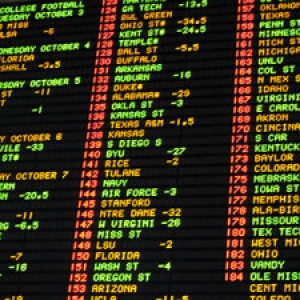
Since the favored team is considered more likely to win, and because no handicap is being used, it takes a larger wager to win a smaller profit on them.
More About Positive Lines
In a 2-team game where one team has a positive money line, they are always the underdog. Since they’re underdogs, it requires a smaller wager to win a larger profit.
Example:
- Pittsburgh Penguins +130
- New York Rangers -150
Sports Betting Money Line Explanation
In this case, a bet of $10 on the Penguins would result in a $13 profit if they win, for a total payout of $23 ($10 wager + $13 profit = $23). For the Rangers, it would take a bet of $15 to win $10 in profit, for a $25 total payout ($15 wager + $10 profit = $25).
Games Where Both Teams Are Negative
In games like baseball or football, it’s not uncommon to see both teams represented with a negative money line. When this happens, it means the teams are very closely matched.
For Example:
- New York Yankees -113
- Boston Red Sox -107
In the scenario above, the game is considered very close, with a slight edge towards the Yankees. It would require a bet of $113 to win $100 on the Yankees, or $107 bet to win $100 on the Red Sox.
Sports With Multiple Teams or Competitors
Of course there are sports with multiple competitors in a single event, like horse racing, Olympic events, and golf. This is also the case in futures bets, where the handicapper is choosing between multiple teams to win a seasonal champion.
In this case, there will generally be one favorite, indicated with a negative money line, and the rest of the field will have positive money lines. Sometimes, when there are no clear favorites, there may not be a single competitor with a negative money line. In this case, the competitor with the lowest positive money line is favored.
Example:
Tiger Woods +600
Phil Mickelson +850
Martin Kaymer +1300
Lee Westwood +1600
Steve Stricker +2300
In this case, Tiger Woods is the favorite, but he has a positive money line. A bet of $10 on him would result in a $60 profit if he wins. A bet of $10 on Steve Stricker would result in a $230 profit if he were to win.
Converting Moneyline Odds to Fractional Odds
We all learned how to do fractions in elementary school, and once you understand money line odds, the conversions are simple.
How to Convert Positive Money Lines to Fractional Odds
:max_bytes(150000):strip_icc()/GettyImages-200565224-002-58b745465f9b58808052cbc4.jpg "Sports betting money line strategy")
To convert a positive money line into fractional odds, divide the number in the money line by 100.
Examples:
Sports Betting Money Line Calculator
- +250 Money Line: 250/100 = 2.5/1 (5/2) Fractional Odds
- +400 Money Line: 400/100 = 4/1 Fractional Odds
- +650 Money Line: 650/100 = 6.5/1 (13/2) Fractional Odds
How to Convert Negative Lines to Fractional Odds
To convert negative money lines to fractional odds, divide the number in the money line by 100. Put that number on the right side of a fraction which begins with ‘1/’. Some numbers on the right side of the fraction will have a decimal in them. Since decimals are not used in fractional odds, they are removed by multiplying both numbers in the fraction by 2.
Examples:
- -200 Money Line: 200/100 = 2. Put the 2 on the right side of a fraction beginning with 1/, resulting in fractional odds of 1/2.
- -350 Money Line: 350/100 = 3.5. Put the 3.5 on the right side of a fraction beginning with 1/, resulting in fractional odds of 1/3.5. Multiply both numbers in the fraction by 2 to remove the decimal = 2/7 fractional odds.
- -650 Money Line: 650/100 = 6.5. Put the 6.5 on the right side of a fraction beginning with 1/, resulting in fractional odds of 1/6.5. Multiply both numbers in the fraction by 2 to remove the decimal = 2/13 fractional odds.
Converting to Decimal Odds
Positive money lines show the profit that would be won from a $100 bet, not including the original wager. Negative money lines show the wager required to win $100 in profit. Neither of these reflect the total payout. This is different in decimal odds.
Using decimal odds, a handicapper can easily calculate their entire payout. For example, a team with decimal odds of 3.0 would be multiplied by the wager amount to calculate the entire payout. A $20 bet with 3.0 decimal odds would pay out a total of $60 ($20 x 3.0 = $60).
The calculation to convert a positive money line to decimal odds is different from the calculation of a negative money line to decimal odds. Here’s how they convert:
How to Convert a Positive Money Line to Decimal Odds
To convert a positive money line to decimal odds, divide the money line by 100, then add 1.
Examples:
- +200 / 100 = 2 + 1 = 3.0 Decimal Odds
- +350 /100 = 3.5 +1 = 4.5 Decimal Odds
- +625 / 100 = 6.25 +1 = 7.25 Decimal Odds
Negative Lines to Decimal Odds
To convert a negative money line to decimal odds, start with the number 100 and divide it by the number in the money line, then add 1.
Examples:
- -200 Money Line: 100 / 200 = .5 +1 = 1.5 Decimal Odds
- -350 Money Line: 100 / 350 = .286 +1 = 1.286 (1.29) Decimal Odds
- -625 Money Line: 100 / 625 = .16 +1 = 1.16 Decimal Odds
Pros & Cons of Money Line Bets
When compared to a point spread, for the underdog, the benefit of a money line bet is the increased odds a handicapper receives. For the favorite, the benefit is that no handicap is given to the underdog, making it more likely their bets will win.
For the underdog, the negative is that they don’t receive a handicap, making it more difficult to win these bets. For the favorite, the negative is that the punter receives lower odds than they do when they’re giving up points on the spread.
Comparing the money line to the run line in baseball or puck line in hockey, the benefit ‘can’ be slightly reduced juice (vig, or commission). For example, many online sportsbooks charge a 5% vig on baseball or hockey money line bets. However, it’s harder to find reduced juice on run lines and puck lines, where punters normally pay 10% vig. Over the course of a season and a lot of bets, 5% can be the difference of being a winning or losing handicapper.
Money lines are the most popular way to bet on MLB baseball and NHL hockey, so the lines can move dramatically from the time they’re posted to the time they close. If you know how to watch lines move and predict where they’re going, money lines can offer a lot of value. For example, when betting on big underdogs in baseball, the best money line odds can often be found as soon as the lines open – before other bettors see the same value you do and bring the odds down. For big favorites, it’s often best to wait until 1-2 hours before game time. For big games with a lot of action, sharp bettors often place big wagers just before a game, which can also create optimal betting opportunities.
For casual bettors, money line bets are easier to make. There is no point spread to mull over, and all that matters is that you choose the winner.
How to Read Betting Lines
If your sports betting experience consists mostly of office pools during March Madness or a casual wager between you and a friend while you watch the Super Bowl, the transition to serious sports betting means learning how to read betting lines. The biggest difference between making the kind of casual bets mentioned above and placing wagers with online sportsbooks or at brick-and-mortar bookshops is the use of sports betting lines. Casual wagers usually involve each person in the bet picking one team to win, then wagering an equal amount, say $20 or $30. Professional bookmakers, online sports betting exchanges, and sports betting facilities in casinos have a more complex system for offering wagers on sporting events, in part to ensure profit on the part of the book, and in part to present a standardized representation of odds.
Let’s start with the basics: what do sports bettors mean when they talk about a ‘line?’ The word line, in the language of a sportsbook, can refer to either the odds and/or a point spread in any sports contest. Let’s take a look at an imaginary line the way you’d read it off the board sitting in a Vegas sports betting lounge or on the screen at your online book. Let’s imagine a game between the New York Giants and the Dallas Cowboys. Your book’s NFL betting line might look something like this:
DAL -7.5-110 -405
NYG +7.5-110 +300
56.5 ov-110
What may look like a jumble of words, numbers, and punctuation is actually a precise and easy-to-read breakdown of the various odds and point spread details your book is offering. Here is a breakdown of each unit of information given above. Once you understand each part of the jumbled details above, you’ll be able to read a sports betting line with confidence.
The Point Spread
Obviously, the first three letters on the top two lines of the three-line package of symbols represents a team in the game you’re wagering on; NYG stands for the New York Giants, while DAL stands for the Dallas Cowboys. The number next to each team’s name is known as the spread or the point spread. Wagers on the point spread are among the most popular sports wagers in the world. The reason this wager is popular is that it doesn’t matter which team wins or loses; what matters is the amount of points the teams score, and whether or not the team you place your money on beats the difference in points (the ‘spread’) or not.
Placing a point spread bet means gambling on how much a team will win or lose by. In our above example, the Cowboys are the favorite. How do we know that? The minus symbol in front of the point spread indicates that the bookmaker thinks the final score will have Dallas winning by 7.5 points or more. The underdog, in our example that’s the New York Giants, will always be indicated with a plus sign. If you wager on the Cowboys on the point spread, America’s Team will have to win by at least 8 points for your wager to pay off. Should the Cowboys win by less than 8 points, your bet is lost.
A wager on the Giants on the spread does not mean that New York has to win the game in order for you to win cash. All the G-Men have to do is come within 8 points of the ‘boys, and you’re a winner. You determine a winning or losing point spread by adding or subtracting 7.5 from the final score, depending on which side you laid your bet. If you’re confident that New York will at least come within a touchdown of beating the Cowboys, or beating them outright, then you’d wager on the spread in favor of New York.
A quick word on that annoying half point in the point spread – most lines you’ll come across will use half points, but it’s not standard practice across the board. When you see a line with a full number instead of a number with a half point, your wager could end up as a push. In our example, if the line were 7 instead of 7.5 and the final difference in points was exactly 7, your wager is returned to you, and neither you nor the book makes money.
What’s the function of the second number in the line?
Sports Betting Winning Systems
The second number in our example (-110 for both teams) tells you how much you have to wager in order to win $100. It’s an easy way to calculate how much you’ll win if your bet pays off, presented in units of $100 at a time for simplicity’s sake. Most of the time, these two numbers will be the same, because oddsmakers want to set lines so that they get as much action on the underdog as on the favorite, guaranteeing them a profit. If a book gets a single bet of $110 (by a customer hoping to win $100) on the Cowboys and a single bet of $110 on the Giants, it will have taken in $220, but will only have to pay back $210 to whichever customer wins the bet. That’s a guaranteed profit of $10, and since sportsbooks take far more than a single bet in either direction, they stand to earn that seemingly small amount of profit many times over. The $10 difference between what you wager and what you win is known as juice or vig in the sports betting industry, and it’s the way books earn their bread and butter.
What does the last number in the line mean?
The last number in the top two rows of our sports line example is known as the money line. If you’re not interested in betting on the point spread, you can wager on a team to win outright. The plus sign next to the underdog (in our case, the Giants) indicates how much money you’ll earn for every $100 you bet on the money line. Conversely, the minus sign next to the favorite’s line tells you how much you have to wager in order to win $100. In our example, a $100 wager on the Giants earns you $300 should they pull off the upset, while a bet of $405 on the Cowboys will net you an extra $100. Representing odds in units of $100 makes placing different size bets easy; if you want to bet $10 on the Giants, you stand to earn $30 if they win, while a $40.50 bet on the Cowboys will net you an additional $10.
Delaware Sports Betting Money Line
What does the bottom row of numbers and letters mean?
The final line of information in our example line is the over-under. Wagers placed on the over-under have nothing to do with which team wins or the difference between the points they score, but rather the combined number of points both teams will score in the game.
The first number (56.5 in our sample line) is the book’s predicted total score, while the second number (110 in our Giants/Cowboys rivalry game) is how much a punter has to bet in order to win $100. If you were to bet the over-under on this game, you’ll have to decide whether you think the combined score of both teams will be higher or lower than the number put up by the book. Let’s say you bet the over, assuming the game will be a shootout between two talented offenses, you’re hoping that the final score will be anything that totals 57 or more. It could be Dallas 54, New York 3, or any other point combination that adds up to 57 or more and your bet will win. Betting the under means that the two teams cannot score more than 56 points combined, or else you lose your bet.
Reading sports betting lines becomes easier with practice and experience with different sporting events. What looks like a jumble of letters and numbers actually gives a lot of information in a tiny amount of space. Different sports have different types of wagers available, such as the run line in baseball or the puck line in hockey, both of which replace the money line found in our football example. The more experience you have watching and gambling on different sports, the faster you’ll be able to read betting lines.